Private Aviation in the GCC and Wider Middle East During the 2026 US–Iran Conflict
Total private flying neared 2025 levels. Charter and fractional flying did not.
Key findings
Main finding: a two-speed recovery. By late summer, total private flying in the Middle East was back close to 2025 levels, but flying on hired jets was not. The difference is accounted for by non-charter private flights, meaning all private flights that are neither charter nor fractional. There were more of these flights than in 2025. The published data did not show who was flying them.
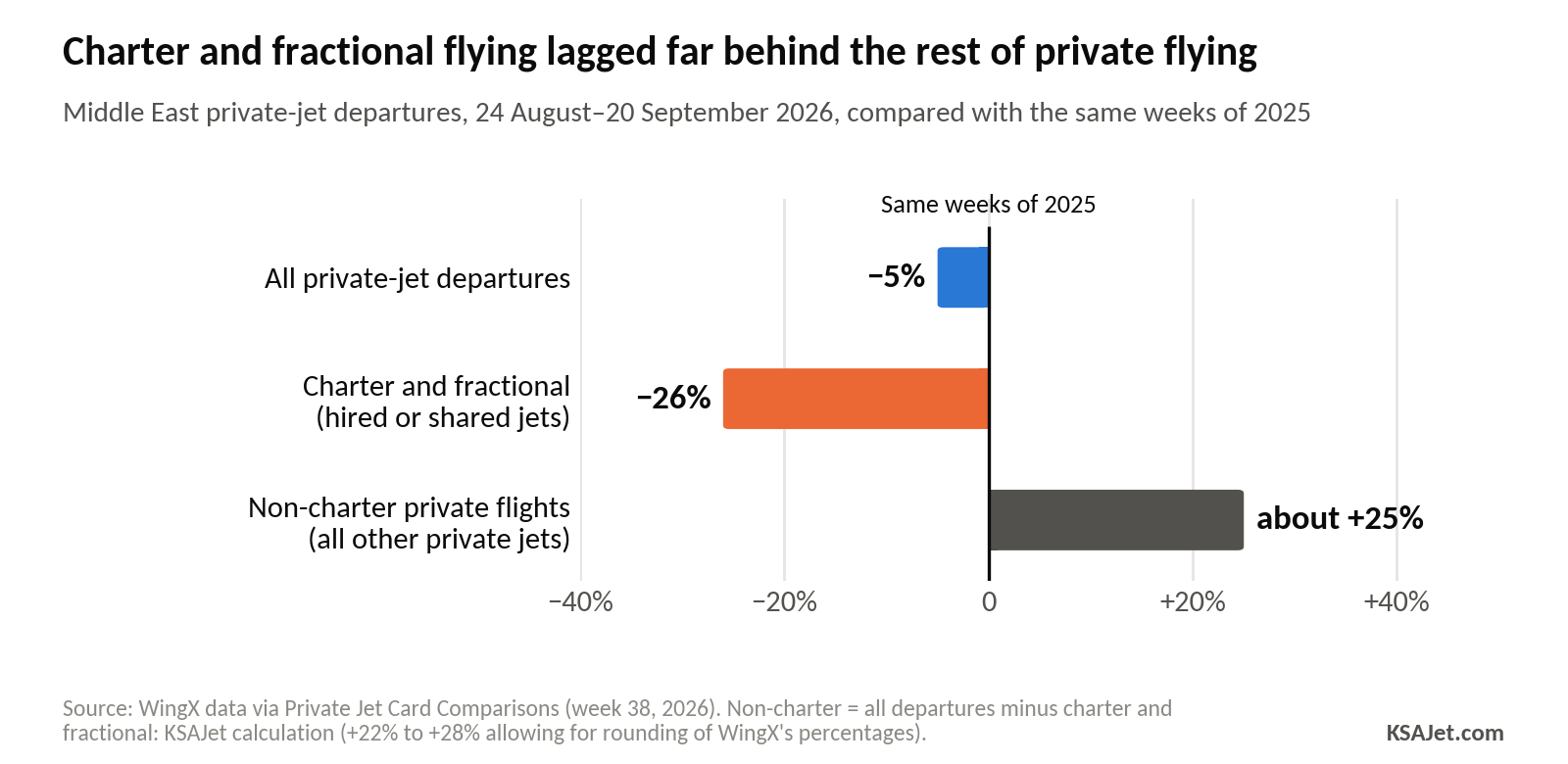
- Total private flying neared 2025 levels; hired jets did not. In the four weeks from 24 August to 20 September, private-jet departures in the Middle East were 5% below 2025, but charter and fractional flights (jets hired by the trip or shared through fractional-ownership schemes) were 26% below [1]. By KSAJet’s calculation, all other private flights were about a quarter above 2025, and hired jets’ share of the region’s private flights fell from about 59% to 46% [1].
- A renewed fall in mid-September, concentrated in hired jets. In the week to 20 September, Middle East private-jet departures fell 19% year on year while global activity was flat, and charter and fractional flights fell 38% [1]. By KSAJet’s calculation, non-charter private flights were slightly above 2025 that week [1].
- The Middle East was the only region to shrink. In January–July 2026, private-jet departures in the Middle East fell 15.7% while global departures rose 4.0%, and every other region in WingX’s breakdown grew [2].
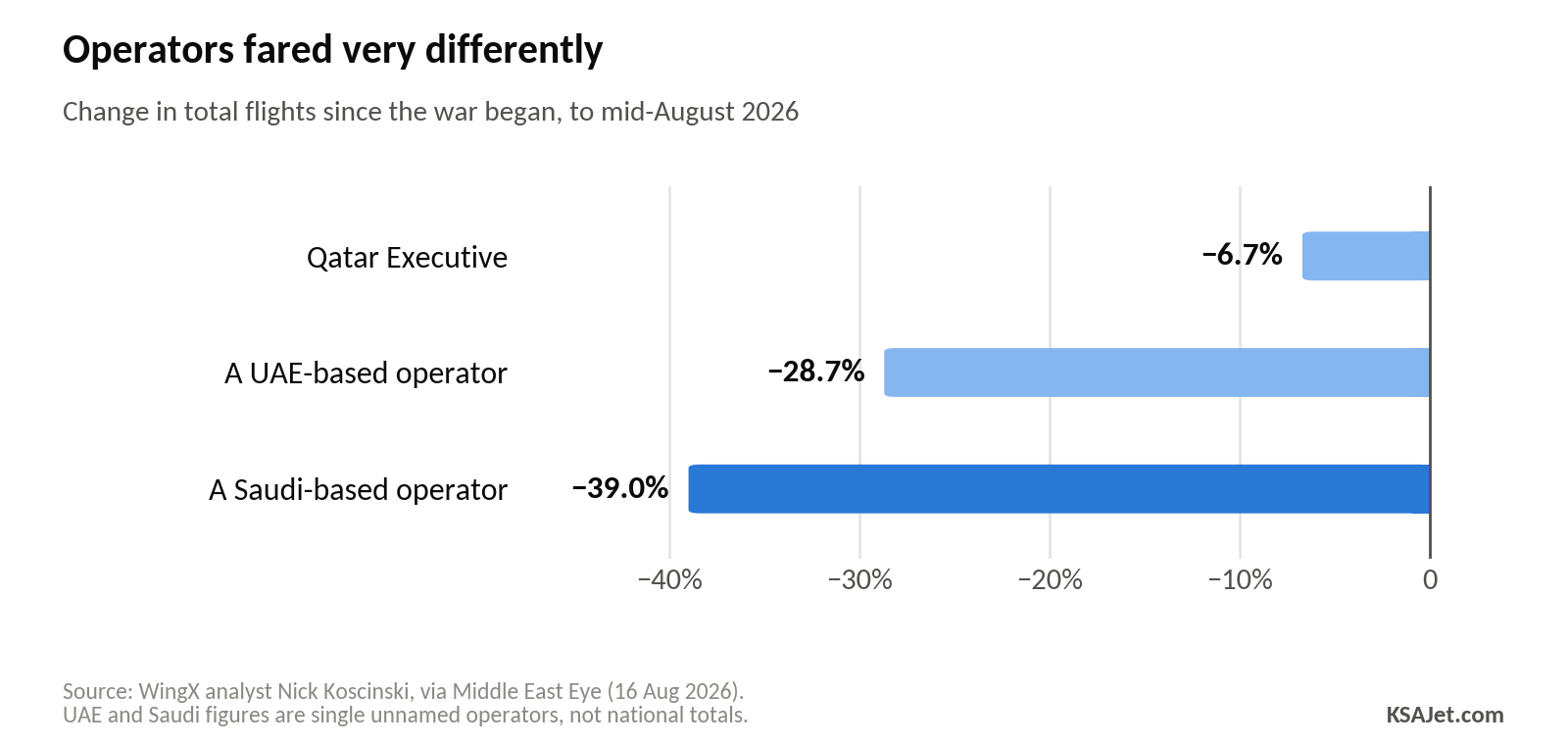
- The Gulf fell further than the wider region. Private-jet traffic from the Gulf states was down 46.5% from the start of the war to 10 August [3], against about 30% for the Middle East as a whole to 28 June [4]. Single operators varied widely, from a 6.7% fall at Qatar Executive to 39.0% at one Saudi-based operator [3].
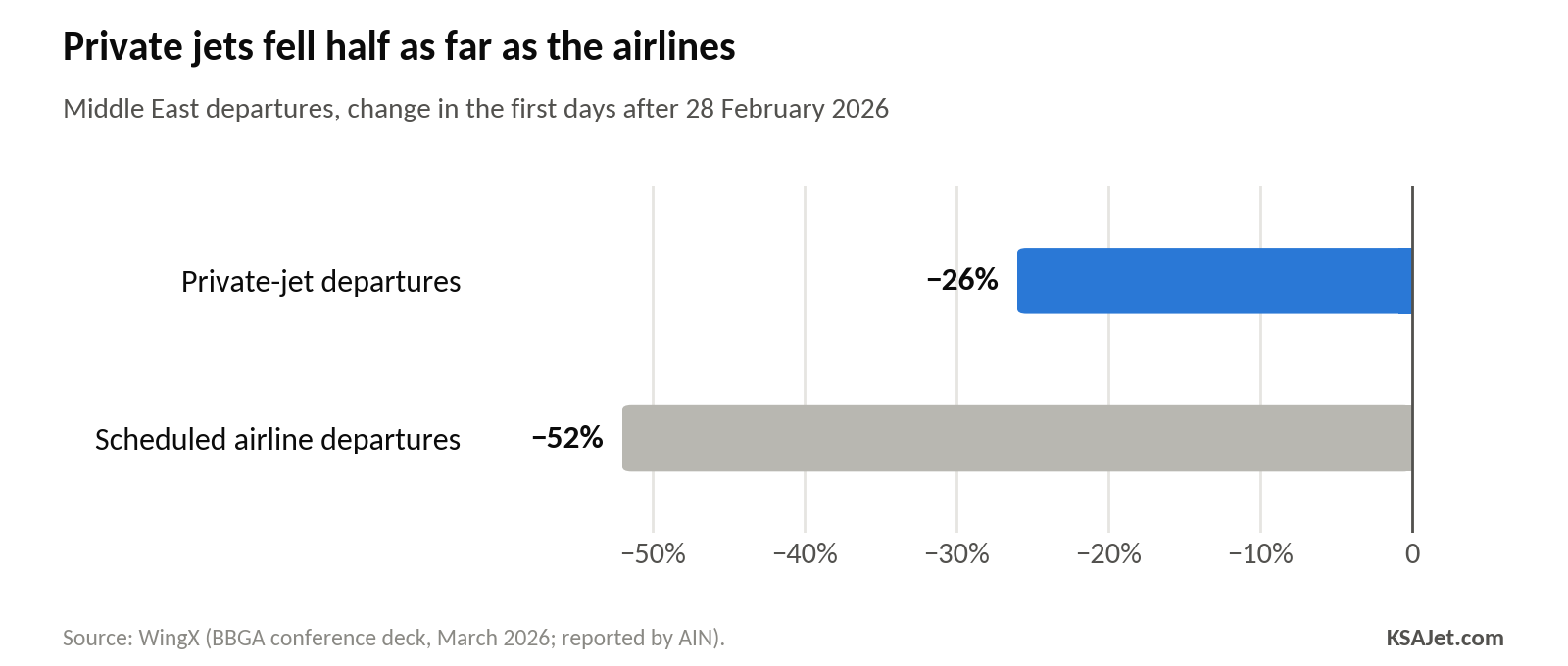
- Private jets held up better than the airlines. In the first days of the war, private-jet departures from the Middle East fell 26%, half the 52% fall in scheduled airline departures [5].
- At Muscat, private flights made up 31% of all operations on 4 March. The figure, for Muscat International Airport, is from Flightradar24 [6]. SHY Aviation’s chief executive said private-jet flights from Muscat, Dubai and Riyadh reached 98 on one day in the first week of March, against a normal 10 to 15. The basis of the count was not reported [7].
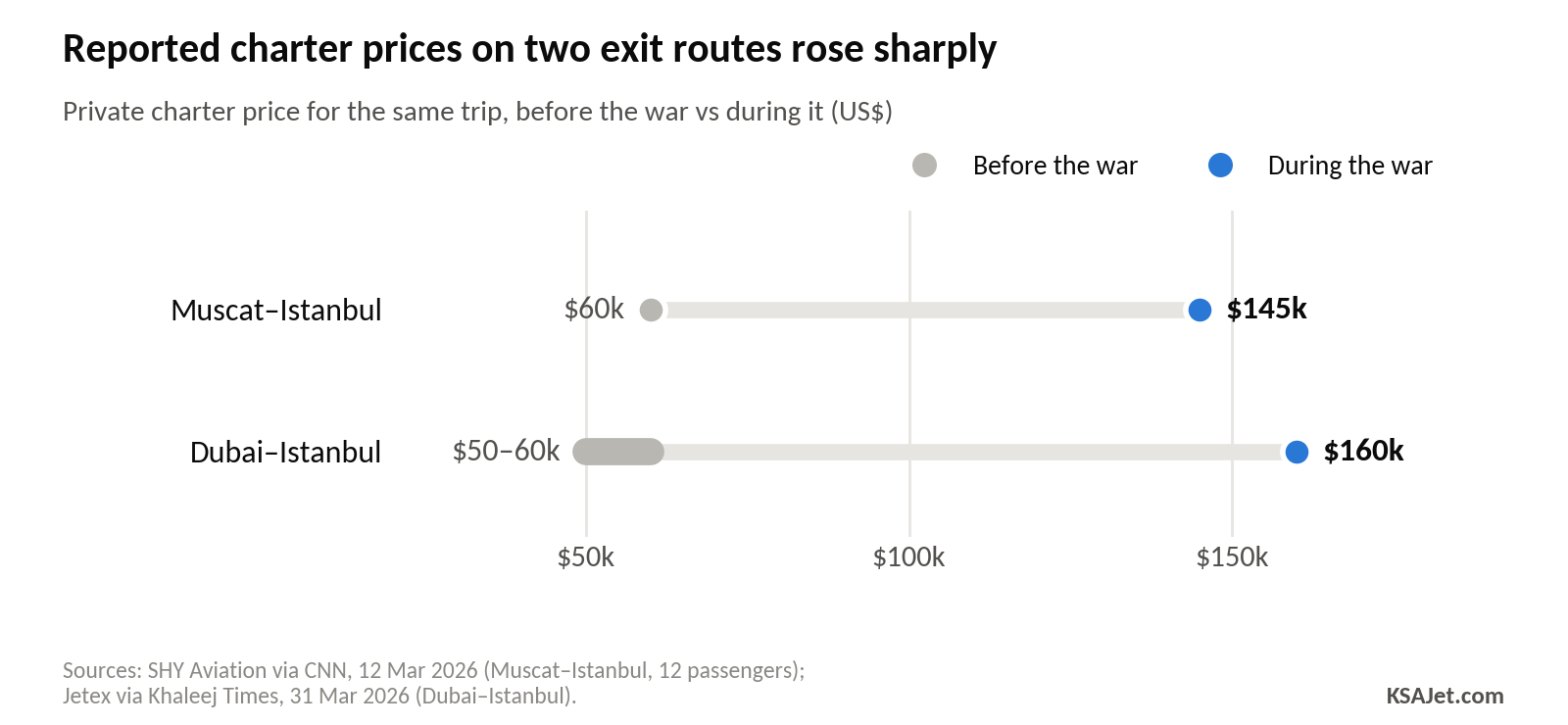
- Prices on exit routes rose sharply, with several reports of doubling. Reuters reported in early March that the broker Jet VIP’s fares for Dubai–Istanbul had doubled, from $50,000 to $100,000 for a light jet [8]. By late March, Jetex put a Dubai–Istanbul charter at about $160,000, against $50,000–60,000 before the war, as rerouting stretched the flight from four hours to six and a half [9].
- War-risk insurance reached $50,000 a flight. Brokers reported premiums of up to $50,000 per private-charter flight, against a typical $5,000–10,000 before the conflict, according to the Financial Times [10].
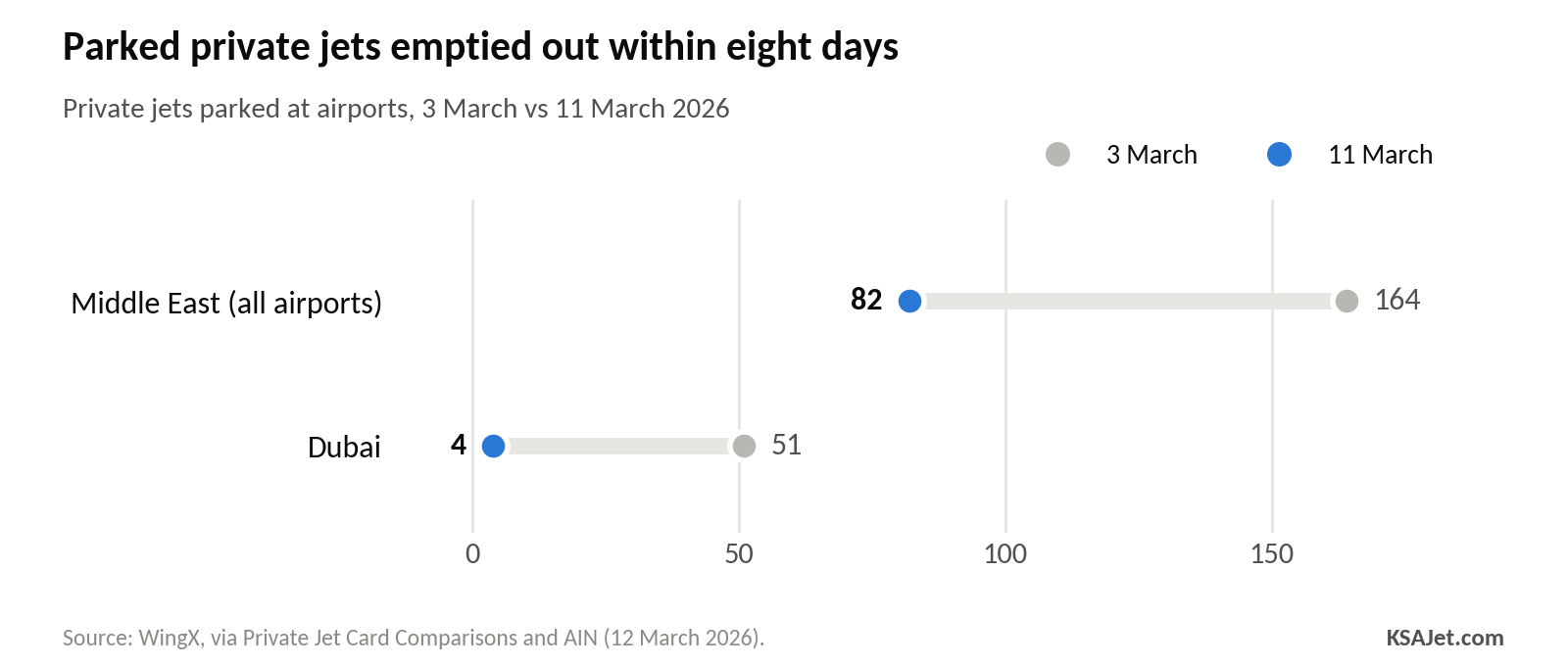
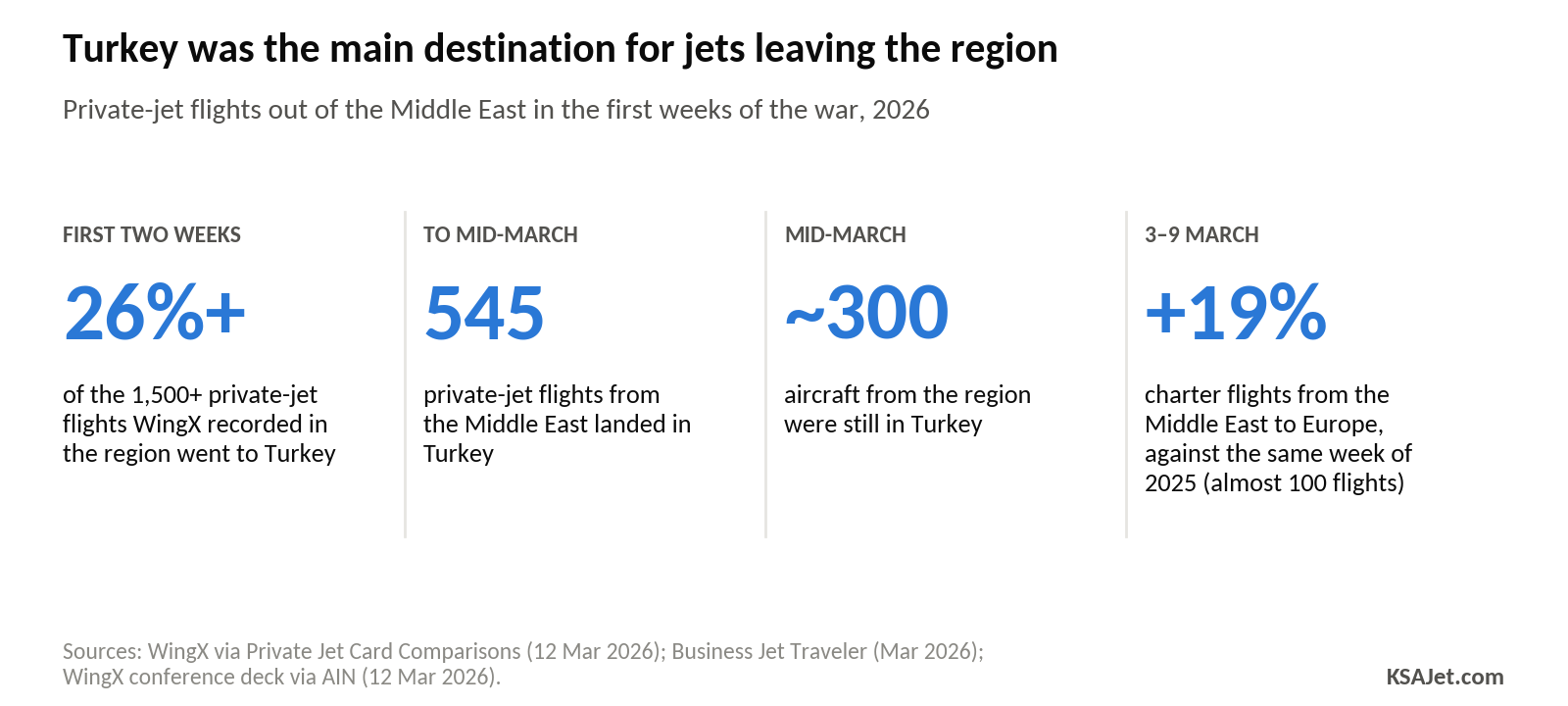
- Aircraft moved out fast. Parked private jets at Dubai fell from 51 to 4 in eight days [11]. Of the more than 1,500 private-jet flights WingX recorded in the region in roughly the first two weeks of the war, over 26% went to Turkey [12].
- UAE searches for “private jet” peaked in the first week of the war. They were about four times the same week of 2025, the highest level between January 2025 and September 2026, and fell back within three weeks [13]. Searches show interest, not bookings: private-jet departures that week were still below 2025 [12], and Saudi Arabia showed no comparable spike (KSAJet analysis of Google Trends data) [14].
- Saudi Arabia was an open route out, but the published data did not show whether it gained. Saudi airspace was reported open in early March [15] and again on 2 September (the date of the latest airspace report used here) [16]. Brokers said Riyadh had become a travel hub for people leaving Dubai, though less so than Muscat [17], and Riyadh–Europe charters were quoted at up to $350,000 [15, 18]. But KSAJet found no published 2026 private-jet movement figures for Saudi airports, in English or Arabic, and the only two Saudi-specific figures found for 2026 both showed declines [3, 19].
Published figures for the Middle East’s decline range from under 5% to nearly 50%, because they measure different things over different periods. The table in section 11 sets out which is which.
1. About this report
The conflict hit the whole aviation industry: in June, IATA forecast that Middle East airlines would swing from a $7.2 billion profit in 2025 to a $4.3 billion loss in 2026, the only region expected to lose money [20]. This report looks at what it did to private aviation.
It brings together the published data on private aviation in the six Gulf Cooperation Council (GCC) states during the conflict that began on 28 February 2026. It covers charter demand, aircraft movements, emergency travel and how operators, brokers and insurers responded, from the first strikes to 20 September 2026. It does not cover events after that date.
Most flight-tracking figures come from WingX, whose “Middle East” region is wider than the GCC (see section 16). Where a GCC or country figure has been published, the report uses it. Where none has, it uses WingX’s figure for the wider region and says so. It does not cover other countries in that region separately. The table shows what was found for each place.
| Place | What this report has for 2026 |
|---|---|
| Saudi Arabia | Airspace status, its role as a route out, search data and two private-flight figures. No airport movement figures were found (section 13) |
| UAE | Parked aircraft at Dubai, prices on Dubai routes, one terminal operator’s capacity, one operator’s flights, search data and airspace status |
| Oman | Private flights’ share of operations at Muscat on 4 March, its role as a route out and airspace status |
| Qatar | Qatar Executive’s flights and airspace status |
| Kuwait and Bahrain | Airspace closures and status only |
| The Gulf states together | Private-jet traffic since the war began, as a single figure, and flights from the Gulf to Europe |
| The wider Middle East (WingX’s region) | Weekly and monthly private-jet departures, and the split between charter and non-charter flights |
| Other countries in the region | No separate figures. Turkey appears only as a destination |
This report compiles published data and adds two pieces of KSAJet’s own analysis: a calculation of non-charter private flights from WingX’s published counts (section 10), and an analysis of Google search data for Saudi Arabia and the UAE (section 14). Every other figure comes from a named, published source: flight-tracking data from WingX, Cirium and Flightradar24; regulators and industry bodies including GACA, EASA and IATA; and statements by operators and brokers reported in the trade and mainstream press. Each figure is cited to its source, listed at the end. Where KSAJet has calculated something from published figures, the text says so. The methodology and limitations are set out in section 16.
“Private jets” here means aircraft flown privately rather than by airlines. That covers jets flown for their owners, including companies; jets hired by the trip from charter companies; and jets shared through fractional-ownership schemes. Flight-data companies such as WingX call these “business jets”. This report uses “private jets” throughout, and none of the figures refer to business-class seats on airlines. Airline figures are included where they explain what happened to private flying.
Readers who hold data this report could not find are invited to add to it: see “Add to this study” near the end.
2. Before the war
The region’s private-aviation market entered 2026 growing strongly. The table shows its size before the war.
The market at a glance
| Measure | Figure | Source |
|---|---|---|
| Growth in Middle East private-jet activity, 2025 | Up 17% | [21] |
| Private jets based in the Middle East | About 700 | [2] |
| Different private jets active in the Middle East, 2025 | 3,661 | [2] |
| Private-jet departures by country, year to September 2024 | UAE about 15,900; Saudi Arabia about 14,100; Qatar about 2,900 | [22] |
| Saudi Arabia: private-jet flights, 2024 | 23,612, a record, up 24% | [23] |
| Saudi Arabia: growth by airport, 2024 | Jeddah up 30%, Riyadh up 22%, Dammam up 7% | [24] |
| UAE: private-jet movements at Dubai South, 2025 | 20,289, a record, up 17% | [25] |
The country figures are not directly comparable, because WingX counts departures and GACA, Saudi Arabia’s General Authority of Civil Aviation, counts flights. The Dubai South figure is for the Mohammed Bin Rashid Aerospace Hub, the UAE’s main private-aviation hub [25].
GACA’s 2024 total was made up of 9,206 domestic flights, up 26%, and 14,406 international flights, up 15% [23]. (GACA’s component growth rates imply total growth of about 19%; the 24% headline uses GACA’s rounded 2023 figure of 19,000.) For 2025, an Airbus Corporate Jets analysis of WingX data showed business-aircraft departures in Saudi Arabia up 20.9% in the first ten months of the year, compared with the same period of 2024 [26].
Saudi Arabia’s regulatory changes
Regulatory changes coincided with that growth, and operators credited them for it. Since October 2023, private jets have been able to fly into and out of the Kingdom carrying different passengers, ending costly empty return legs (in Arabic) [27]. From 1 May 2025, foreign charter operators could apply to fly domestic routes [23]. GACA’s review of 2025 lists VistaJet and Flexjet as licensed for on-demand private flights under that rule [28]. One operator, Vista, said its Saudi flights rose 59% year on year in the first quarter of 2024 [29]. VistaJet, part of Vista, announced in August 2025 that it was the first foreign operator to offer flights within the Kingdom, and said its Saudi programme members rose 32% year on year in the first half of 2025 [30]. Air Charter Service opened its first Saudi office, in Riyadh, in September 2025 [31]. GACA’s General Aviation Roadmap aims to make general aviation a $2 billion industry by 2030, supporting 35,000 jobs, with six dedicated private-aviation airports and nine private-aviation terminals [23, 24].
3. Timeline
The EASA bulletins listed below are advice to European operators. Only a state can close its own airspace.
| Date | Event |
|---|---|
| 28 Feb 2026 | US–Israeli strikes on Iran. At least eight states, including Qatar, Bahrain, Kuwait and the UAE, declared their airspace closed [32]. |
| 28 Feb | EASA issued a conflict-zone bulletin for the Middle East and Persian Gulf. As revised on 1 July, it covered the airspace of 11 states, including Saudi Arabia and Oman [33]. |
| 28 Feb – 23 Apr | Kuwait suspended all flights at Kuwait International Airport. Its airspace reopened on 23 April after nearly two months, with flights resuming gradually from 26 April [34]. |
| 8 Apr | A temporary US–Iran ceasefire was announced [33]. |
| 3 Jun | Iranian drones heavily damaged a passenger terminal at Kuwait International Airport that had reopened two days earlier, on 1 June, killing one person [35]. |
| 17 Jun | A memorandum of understanding extended the ceasefire by 60 days [33]. |
| Early Jul | The ceasefire broke down, with renewed military action around the Strait of Hormuz [36]. On 8 July, US President Donald Trump said it was over, as the US struck about 90 Iranian targets [37]. |
| 8 Jul | EASA let its regional bulletin lapse, replacing it with an information note on the remaining medium-level risks and separate bulletins for Iran, Iraq and Lebanon [38]. |
| 14 Jul | A new EASA bulletin advised operators not to fly in the airspace of Bahrain, Kuwait, Qatar and the UAE, or over the Gulf of Oman west of 58°E, at any altitude [39]. |
| 18 Jul | Kuwait closed its airspace again after renewed Iranian missile and drone attacks [40]. |
| 31 Aug | EASA extended the bulletin to 30 September and revised its recommendations to reflect a change in the risk level [41]. |
| By 2 Sep | OPSGROUP reported a further round of US strikes on Iran, and that Iran responded with attacks on US bases in the region [16]. |
| Mar – Sep | Saudi airspace was reported open to commercial and private flights in early March and again on 2 September (the date of the latest airspace report used here) [15, 16]. |
4. The first two weeks
Departures fell sharply when the war began. WingX recorded 371 private-jet departures from Middle East airports between 27 February and 1 March [19], 30.8% fewer than in the same period of 2025 [19]. WingX’s conference figures for the first days of the war showed private-jet departures down 26%, against 52% for scheduled airline departures [5].
Across the whole of week 9, the week the war began, private-jet activity in the Middle East was 29% below the same week of 2025. A week later the gap had narrowed to 4%, with about 1,137 flights, up 7% on the previous week [12].
The rebound did not mean a return to normal, because many of the departing jets were leaving the region. Parked private jets across the Middle East peaked at 164 on 3 March and fell to 82 by 11 March [12]. At Dubai, the number fell from 51 to 4 [11]. By 17 March the regional count was down to 69, and all 51 jets that had been parked at Dubai on 3 March had left [42]. SHY Aviation, a London-based charter firm, said private-jet flights from Muscat, Dubai and Riyadh, normally around 10 to 15 a day, reached 98 on a single day in the first week of March. The basis of the count was not reported [7].
About half of scheduled airline departures from the Middle East to other regions were cancelled between 28 February and 16 March: 28,990 of 57,223, according to Cirium data that exclude Turkey and flights within the region [43].
For people who needed to leave, a private jet was often one of the few seats available. That is likely one reason private flying fell so much less than airline flying.
5. Emergency travel
The states reported as closing their airspace on 28 February did not include Oman or Saudi Arabia [32]. Departures moved to those two neighbours.
Muscat became the main exit. On 4 March, private flights made up 31% of all operations at Muscat International Airport, according to Flightradar24 [6]. In a Forbes report published on 2 March, broker spokespeople said that Muscat and, to a lesser extent because of visa restrictions, Riyadh had become travel hubs for people leaving Dubai [17].
Getting to those airports meant long drives. Travellers drove about ten hours from Dubai and nearly seven from Doha to reach Riyadh, and one passenger described a four-hour drive from Doha to Dammam [15]. Private security firms were reported to be booking convoys of SUVs for the Dubai–Riyadh drive [6]. Seven stranded professional golfers and a caddie drove more than four hours to Oman before flying on to Hong Kong [6].
Brokers, operators and security firms described a surge in requests, including from companies moving their staff:
- Air Charter Service, a UK-based broker with an office in Riyadh [31], arranged more than 70 evacuation charter flights out of the Middle East by 14 March [44], including more than 20 private jets from Muscat in the first days, most often to Istanbul [44].
- Mayfair Jets, a Dubai-based broker, said requests for private jets rose 200–300% within days of the war starting [45].
- Amalfi Jets, a Los Angeles-based broker, said it was seeing “a lot more first-time private fliers” simply trying to get out of the region, and brokers told Arabian Business that bookings briefly doubled in the early days of the disruption [46].
- Vimana Private Jets, a London-based broker, received more than 100 client inquiries overnight at the start of March, demand its chief executive said he had not seen since the pandemic [18], and was still receiving more than 100 a day later that week [15].
- Global Guardian, a US security firm, said that by 3 March seven corporate clients, including large finance and consulting firms, were looking to evacuate 1,000 to 3,000 employees [18].
- Bitlux, a small Florida-based broker, said it received more than 500 evacuation requests in the first hours and arranged seven evacuation flights in the first days [47].
- AirX, a Malta-based operator, said demand for private charter had “increased materially” as airline schedules became limited or unreliable [7], and that it had secured a charter worth around €1 million for a plane with 100 lie-flat seats [7].
- Jet VIP, a France-based broker, said: “every 10 minutes we have requests, every 20 minutes” [8].
Of these firms, only Mayfair Jets is based in the Gulf. The others are based in Europe or the United States, so their figures show the demand that reached international brokers and operators, not the whole market. Figures for three Gulf-based operators are in section 11.
Open airspace, airport slots and permits were bottlenecks, as well as the supply of aircraft (section 6). Jet VIP’s chief executive described scarce slots as traffic spiked at Muscat and Riyadh, and waits of up to 24 hours for authorisation to fly to Oman to pick up passengers [8]. For many travellers, the trip out became a drive to Oman or Saudi Arabia followed by a flight.
Who was flying
KSAJet found no published source that breaks private-jet passengers down by type, and flight data do not identify passengers. The reports above and elsewhere in this report point to five groups:
| Group | What was reported | Source |
|---|---|---|
| Companies moving staff | Seven corporate clients of one security firm, including large finance and consulting firms, were looking to evacuate 1,000 to 3,000 employees by 3 March | [18] |
| First-time private fliers | One broker reported “a lot more first-time private fliers” trying to get out of the region | [46] |
| People leaving Dubai | Muscat and, to a lesser extent, Riyadh became travel hubs for people leaving Dubai. Seven professional golfers and a caddie drove to Oman and flew on to Hong Kong | [6, 17] |
| Large groups | One operator secured a charter worth around €1 million for a plane with 100 lie-flat seats | [7] |
| Gulf travellers in the summer | Travellers from GCC countries who hired jets in the summer holidays booked closer to departure than a year earlier (section 10) | [48] |
6. Prices and costs
Brokers and operators reported sharp price rises on exit routes in March, and several reported prices doubling or more on particular trips. The examples below are individual quotes and bookings.
| Route | Before the war | During the war | Source |
|---|---|---|---|
| Dubai–Istanbul (light jet, 6 passengers) | $50,000 | $100,000 (early March) | [8] |
| Dubai–Istanbul (heavier jet) | $110,000 | $200,000 (early March) | [8] |
| Muscat–Istanbul (12 passengers) | about $60,000 | $145,000 (early March) | [7] |
| Dubai–Istanbul | $50,000–60,000 | about $160,000 (late March) | [9] |
| Flights from Oman | – | at least $100,000, nearly double the usual rate (early March) | [49] |
| Riyadh–Porto (up to 16 passengers) | about €100,000 | doubled (early March) | [50] |
| Riyadh–Europe | – | up to $350,000 (early March) | [15, 18] |
Other reported prices, without pre-war comparisons, were also high. Gulf–Europe charters were quoted at €150,000–200,000 [50]. Light jets from Muscat to Istanbul were reportedly going for more than $93,000 and heavy jets up to $140,000, according to Forbes, as cited by Fox News [6]. Long-range evacuation quotes ranged from $300,000 to $700,000 [47]. In April, one broker reported booking a Dubai–London charter on a Boeing Business Jet for $520,000, against $400,000 for the same trip in 2023, which it put down to the cost of jet fuel [51].
Prices rose for three reasons:
- Scarcity. In the first weeks, demand far outstripped the aircraft, crews and airport slots available in the places people could fly from. This premium appears to have been the shortest-lived. One broker said demand out of the Middle East, particularly Dubai, peaked on 4–5 March, when many local operators were “charging highly inflated rates” and clients were “often paying nearly double” on certain routes, and that “the bubble of highly inflated prices burst over the weekend of 7–8 March”, although prices stayed above normal [46].
- Longer routes. Avoiding Iraqi and Iranian airspace stretched Dubai–Istanbul from about four hours to six and a half [9]. Longer flights cost more for as long as rerouting was needed.
- Higher costs. Brokers told the Financial Times that private charter operators faced war-risk insurance premiums of up to $50,000 per flight, against a typical $5,000–10,000 before the conflict [10]. Jetex said insurance could reach $40,000–50,000 per landing at some locations [9]. Fuel added more: jet fuel rose from nearly $100 a barrel at the start of the year [52] to above $200 by mid-April, while physical crude prices neared $150 a barrel [53]. In the Gulf itself, jet fuel cost more than twice its pre-conflict level by mid-March [42].
Prices stayed higher after the first weeks. By early April, one broker’s booking database showed charter prices (in Arabic) up 5–15% on average and up to 20% on some trips, although its geographic scope was not stated [51]. The same broker said war-risk surcharges of $8,000–10,000 per trip had been passed on to customers on three flights [51]. For comparison, foreign airlines were quoted $70,000–150,000 in extra insurance per flight into the Gulf [54]. By July, crude oil and jet fuel prices had eased from their spring peaks but were still above pre-conflict levels [2]. JETNET’s barometer of 5 October, with data to August, said prices had eased through the spring and summer but had since turned higher again [55].
7. Where the aircraft went
Over the weekend the war began (27 February–1 March), Turkey took nearly a quarter of private-jet flights leaving the Middle East, and France, Greece, Italy and the UK together took 18.7% [19]. In roughly the first two weeks, WingX recorded more than 1,500 private-jet flights in the region, over 26% of them to Turkey [12]. By mid-March, 545 flights from the Middle East had landed in Turkey, and nearly 300 aircraft were still there [42]. Operators at first limited flights to destinations such as Istanbul, where permits could be obtained quickly and aircraft could fly short rotations, and one broker said most of the jets used for evacuation trips were being flown in from Turkey, Asia or Europe [46]. Over the year, the number of different private jets active in the Middle East fell from 3,661 in 2025 to 3,545 in the twelve months to July 2026, a fall WingX attributed to the conflict [2]. One broker named Istanbul as the most popular destination; others included Athens and Mumbai [7]. Between 3 and 9 March there were almost 100 charter flights from the Middle East to Europe, 19% more than in the same week of 2025 [11].
Private-aviation fuel uplift in the region, a proxy for activity, stayed more than 40% below pre-conflict levels through week 15, to 12 April [21]. At the end of March, Jetex, a Dubai-based private-aviation terminal operator, said it was operating at more than 30% of its usual capacity, up from early March, when activity had nearly stopped [9].
Over the whole period from the start of the war to 10 August, private-jet flights from Gulf countries to Europe were down 41.0%. Europe nevertheless remained the second most common destination after the Middle East itself [3].
8. March to June: the slump
After the exit in the first week of March (section 4), private flying went through two more phases: a slump that was deepest from mid-March to May, and an uneven recovery from June.
Activity fell again after the first-week rebound. The lowest week in the 52 weeks to 20 September was week 11 (9–15 March), with 763 private-jet departures in the Middle East [1]. In week 13, in late March, the Middle East recorded 875 private-jet flights, 41% fewer than a year earlier [56]. By then the year-to-date decline was 14% [56].
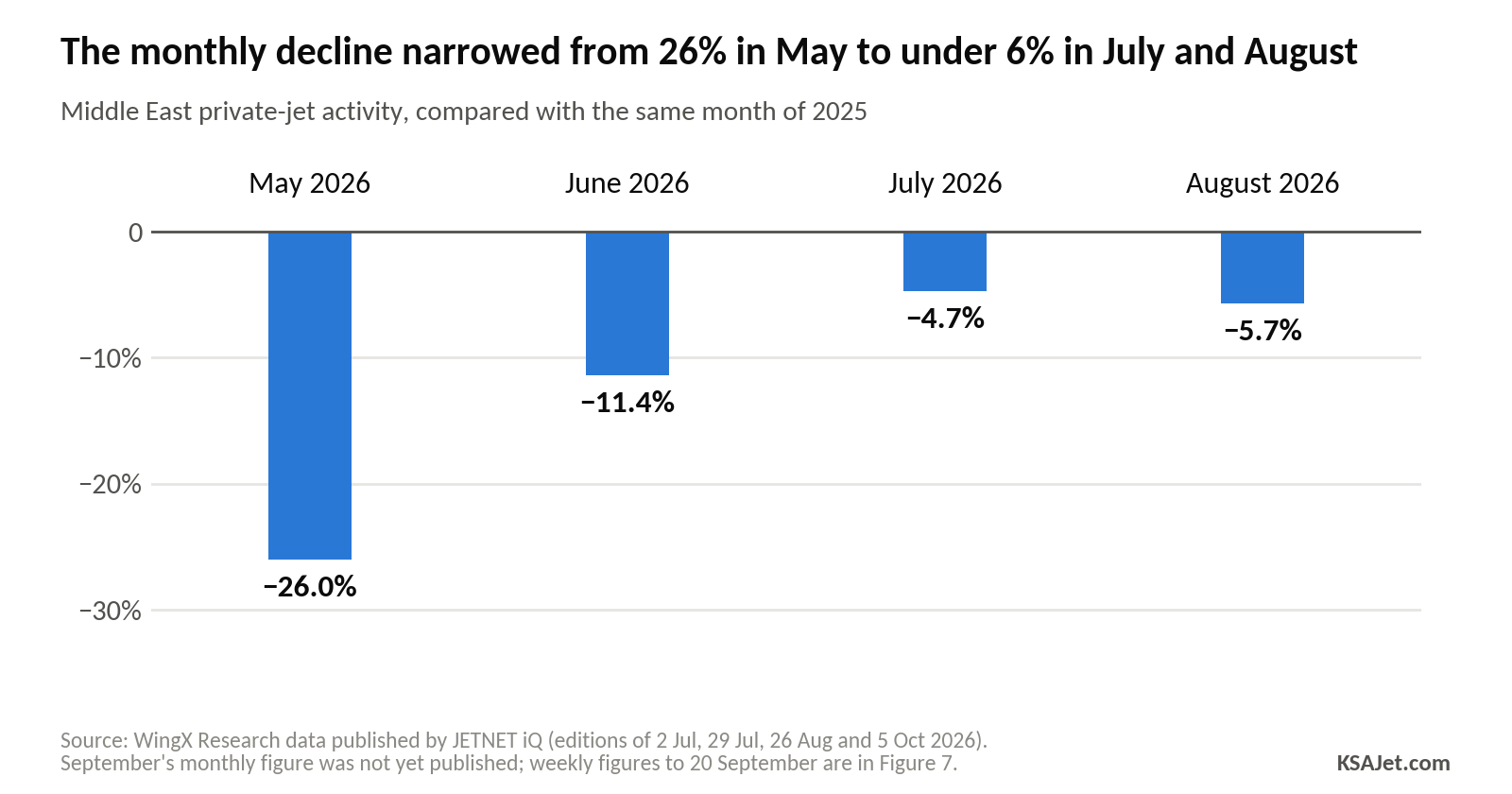
A temporary ceasefire was announced on 8 April [33]. In May, the first full month after it, activity was still 26.0% below 2025, taking the year-to-date decline to 19.1% [57]. Monthly declines eased from more than 20% earlier in the year to 11.4% in June [58], the month the ceasefire was extended by 60 days [33].
Middle East private-jet traffic was down 17.8% in the first half of 2026 [58]. Measured from the start of the war, the fall was deeper: between 28 February and 28 June, WingX counted 15,171 private-jet departures from the Middle East, against 21,529 in the same period of 2025, a drop of about 30% [4].
Flights within the region, the measure closest to the Gulf states themselves, took longest to recover. JETNET’s August report said Middle East activity had been running nearly 50% below pre-conflict norms after the conflict began, and WingX’s tracker of flights within the Middle East showed the gap with 2025 at its widest around the middle of the second quarter [2].
9. July to September: an uneven recovery
The ceasefire broke down in early July [36], and on 8 July the US President said it was over [37]. On 14 July a new EASA bulletin advised operators not to fly in the airspace of Bahrain, Kuwait, Qatar and the UAE [39], and on 18 July Kuwait closed its airspace again [40].
The monthly figures kept improving into July. Middle East private-jet activity was 4.7% below 2025 in July [2], against 11.4% in June [58]. In August it was 5.7% below [55]. For January to July as a whole, the Middle East recorded 34,900 private-jet departures, 15.7% fewer than a year earlier [2].
Weekly figures showed the same. From late June to late August, the total number of private-jet departures in the Middle East came close to 2025 levels. It ranged from 16% below to 4% above 2025, and was below 2025 in six of the seven weeks [59, 60, 61, 62, 63, 64, 65].
Flights within the region recovered more slowly. The gap with 2025 narrowed unevenly, and in two weeks around the end of June and start of July flights within the region were above 2025, but they stayed below 2025 through mid-August. JETNET’s assessment in August was that intra-regional activity was “still stabilising rather than returning to a clear pre-conflict trajectory” [2].
September brought a setback. A further round of US strikes on Iran had been reported by 2 September [16]. In the four weeks to 20 September, total private-jet departures in the Middle East were 5% below 2025 [1]. But in the week to 20 September itself, the Middle East recorded 1,290 private-jet departures, 19% fewer than a year earlier and 12% fewer than the week before; Private Jet Card Comparisons said the region “regressed heavily due to the ongoing conflict” [1]. A single week may not indicate a trend, and later data were not available when this report was completed.
These totals hide a split between hired jets and all other private flights, which section 10 sets out.
10. Charter versus non-charter flights
WingX’s weekly figures split private flights into two groups:
- Charter and fractional flights. Jets hired for a trip from a charter company, or used through a fractional-ownership scheme in which several clients share an aircraft. This is the market brokers sell.
- Non-charter private flights. Everything else in WingX’s count. This is a remainder: it can include jets flown for private owners, company flight departments, and royal or government flights. WingX does not break this group down in its weekly reports, so KSAJet works it out as all departures minus charter and fractional flights.
From late June to late August, total private-jet departures came close to 2025 levels (section 9). Charter and fractional flights did not: they stayed 13–33% below 2025 in every week for which figures were available [59, 60, 61, 62, 63, 64, 65].
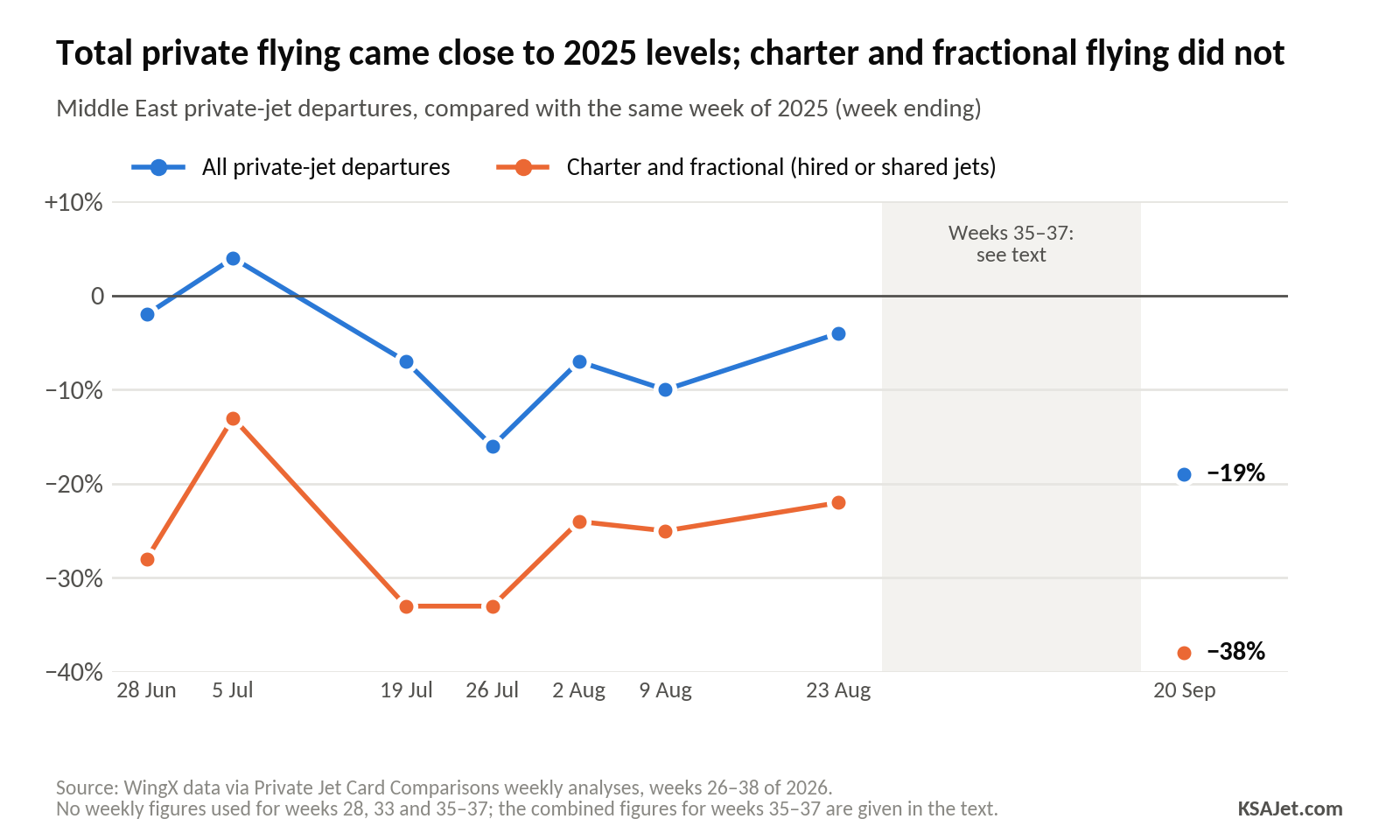
If the total was close to 2025 while the charter and fractional group was well below it, the non-charter group must have been above 2025. KSAJet calculated how far above from WingX’s published counts, for the periods where both exact counts are available [1, 60]:
| Week (2026) | All private-jet departures | Charter and fractional | Non-charter private flights (KSAJet calculation) |
|---|---|---|---|
| Week 27 | 1,651 (+4%) | 781 (−13%) | about 870 (roughly +26%) |
| Week 29 | 1,508 (−7%) | 653 (−33%) | about 855 (roughly +32%) |
| Weeks 35–38 (four weeks to 20 Sep) | 6,037 (−5%) | 2,764 (−26%) | about 3,270 (roughly +25%) |
| Week 38 | 1,290 (−19%) | 539 (−38%) | about 750 (roughly +4%) |
In the two July weeks (weeks 27 and 29), non-charter private flights ran roughly a quarter to a third above 2025. Allowing for rounding of WingX’s percentages, the increase lies between about 24% and 29% in week 27 (29 June–5 July) and between 29% and 36% in week 29 (13–19 July). The calculation assumes the charter and fractional flights are part of the same total.
The calculation measures the amount of non-charter flying. It cannot say who was flying. The published data did not show how much of the increase came from private owners, from company flight departments, or from government and other official flights, which may be more frequent during a conflict. This report therefore does not attribute the increase to any one of them.
September data showed the same split. In the four weeks to 20 September, total private-jet departures in the Middle East were 5% below 2025 and charter and fractional flights 26% below [1]. Non-charter private flights were about a quarter above 2025 (between about 22% and 28%, allowing for rounding). Hired jets made up 46% of the region’s private-jet departures, against about 59% in the same weeks of 2025 [1]. Taking the last of those weeks (week 38, to 20 September) out of the four-week totals, total private flying in the three weeks to 13 September was, combined, about level with 2025, with charter and fractional flights about 22% below [1].
The fall in the week to 20 September (section 9) was concentrated in hired jets. Charter and fractional flights fell 38% year on year, to 539 [1], while non-charter private flights were slightly above 2025 that week, by about 2–6% [1]. Worldwide, private-jet departures were flat that week and charter and fractional flights were 1% lower [1].
Non-charter private flying was therefore at or above its 2025 level from July to September, while the market for hired jets stayed well below 2025.
Those who did hire jets booked later. According to XO, Vista’s booking marketplace, 31% more flights by GCC travellers were confirmed within 72 hours of departure during the summer school-holiday peak than a year earlier, and the typical booking window shrank from about 11 days to nine. London Luton was the most requested European arrival airport [48].
11. The Gulf, the wider region and the rest of the world
The Gulf versus the wider region
The Gulf states fell further than the wider Middle East. From the start of the war to 28 June, private-jet departures from the Middle East as a whole were about 30% below the same period of 2025 [4]. From the start of the war to 10 August, private-jet traffic from the Gulf states was down 46.5% [3]. The end dates differ by six weeks, but both figures are measured from the start of the war, and the gap between them is large.
Results for individual operators varied widely. By mid-August, Qatar Executive’s total flights were down 6.7% since the start of the war, against 28.7% for a comparable UAE-based operator and 39.0% for a Saudi-based operator [3]. Each figure is for one operator only.
Other regions
Global private-jet departures reached 1.95 million in the first half of 2026, up 4.0% [58], and 3.99 million in the twelve months to July, up 4.9% [2]. In January–July, every region in WingX’s breakdown grew except the Middle East [2].
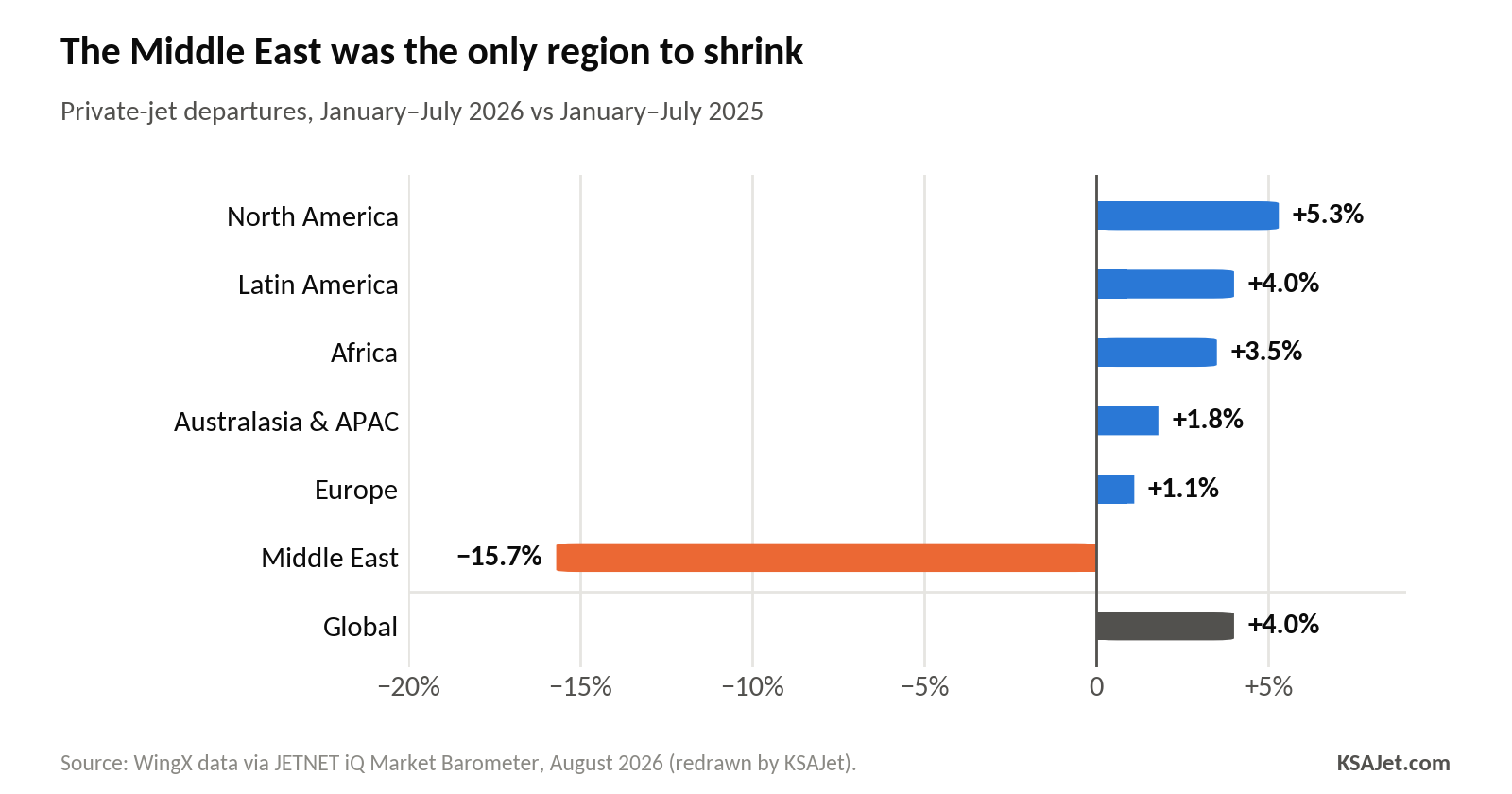
Worldwide, charter and fractional flights combined rose 7% in the first half of 2026 [66], but that growth came from fractional programmes: branded charter operators’ flights fell 2.9% in January–July, while fractional flights rose 11.0% and private flight departments 11.2% [2]. So the Middle East’s shift away from hired jets towards non-charter flights, described in section 10, was a much sharper version of a trend also seen worldwide: its charter and fractional decline of 13–38% from late June to September was far steeper than the 2.9% global fall in branded charter. The Middle East accounted for about 1.7% of global private-jet departures in the twelve months to July 2026 [2].
Which figure is which
Published figures for the Middle East’s decline range from under 5% to nearly 50%. They measure different things over different periods:
| Figure | What it measures | Period | Source |
|---|---|---|---|
| −30.8% | Private-jet departures from Middle East airports | The weekend the war began (27 Feb–1 Mar) | [19] |
| −41% | Middle East private-jet flights in a single week | Week 13 (late March) | [56] |
| −26.0%, −11.4%, −4.7%, −5.7% | Middle East private-jet activity in single months | May, June, July, August | [2, 55, 57, 58] |
| −17.8% and −15.7% | Middle East, year to date; includes January and February, before the war | January–June and January–July | [2, 58] |
| About −30% | Middle East private-jet departures since the war began | 28 Feb–28 Jun | [4] |
| −46.5% | Private-jet traffic from the Gulf states only, since the war began | 28 Feb–10 Aug | [3] |
| Nearly −50% | Middle East private-jet activity after the conflict began, against pre-conflict norms (JETNET’s summary) | Not dated; report of August 2026 | [2] |
| −5% (charter and fractional: −26%) | Middle East private-jet departures, four weeks to 20 September | 24 Aug–20 Sep | [1] |
For a single measure of the war’s effect on the region as a whole, the change since the war began (about −30% to 28 June) is the most direct. Year-to-date figures dilute it with two pre-war months, and single weeks and months move with the timing of holidays.
12. How each part of the industry was affected
KSAJet found less published information about private-aviation companies than about flight numbers. The table sets out what is documented for each part of the industry, with the section that gives the detail, and what KSAJet did not find.
| Part of the industry | What is documented | What KSAJet did not find |
|---|---|---|
| Charter brokers | A surge in requests and evacuation flights in the first two weeks (section 5). LunaJets, a Geneva-based broker, said it was coordinating an evacuation flight from Muscat to Istanbul and assessing further rotations from Riyadh and Muscat, “among the main airspaces remaining open in the region” [67]. Air Charter Service said its UAE- and Saudi-based teams were working on ground and air evacuations [67] | A breakdown of passengers by type. Of the firms quoted, only one is based in the Gulf (section 5) |
| Charter operators | Flights by hired jets stayed well below 2025 from late June to September (section 10). Flights at one Qatari, one UAE-based and one Saudi-based operator were down 6.7%, 28.7% and 39.0% since the war began, as of mid-August [3] (section 11). Some operators passed on war-risk surcharges of about $8,000–10,000 per trip [51] (section 6) | Figures from named operators on moving aircraft or crews to new bases. Crisis-specific products such as guaranteed-availability jet cards or shuttles via Riyadh or Muscat |
| Private terminals and airports | Jetex, a Dubai-based terminal operator, was at more than 30% of its usual capacity at the end of March, up from early March, when activity had nearly stopped [9] (section 7). On 4 March, private flights made up 31% of all operations at Muscat International Airport [6] (section 5) | Private-jet movement figures for Saudi airports in 2026 (section 13) |
| Fuel | Private-aviation fuel uplift in the region stayed more than 40% below pre-conflict levels to mid-April [21], and Gulf jet fuel prices more than doubled [42] (sections 6 and 7) | – |
| Insurance | Brokers reported war-risk premiums of up to $50,000 per flight [10] (section 6) | Published business-aviation war-risk terms from insurers for the Gulf |
| Security firms | Security firms were reported to be booking convoys of SUVs for the Dubai–Riyadh drive [6], and one had corporate clients looking to evacuate 1,000 to 3,000 employees [18] (section 5) | – |
| Aircraft sales | JETNET said buyer confidence “moved fast” once the conflict began: growth in pre-owned private-jet transactions worldwide fell from 16% in December to 1% in March [21], and the twelve-month trend was still only 3% in July [2]. Gulfstream’s first-quarter demand was also eroded by the conflict [68] | Sales data on Gulf-based jets |
| Industry body | The MEBAA Show, the Middle East’s main private-aviation show, was scheduled, as of early October 2026, for 8–10 December 2026 [69] (section 15) | A public statement on the conflict from MEBAA, the regional industry body |
A dash means this report records no specific gap. It does not mean that everything has been published. Some of what was not found may have happened without being published. Anyone who holds it is invited to add to this study (see “Add to this study”).
13. Saudi Arabia
In the first weeks of the war, Saudi Arabia was one of the two open routes out of the Gulf for private travellers, alongside Oman. Both were still reported open on 2 September, although operators were by then advised to avoid the Gulf of Oman west of 58°E [16].
In the first week, Saudi airspace remained open to commercial and private flights while neighbouring Gulf airspace was disrupted [15]. On 2 September, OPSGROUP reported that Saudi airspace was still open and carrying much of the traffic routed south around the conflict zone through the Jeddah flight information region [16].
Brokers said Riyadh, to a lesser extent than Muscat, had become a travel hub for people leaving Dubai [17], and Air Charter Service said the air corridor through Saudi Arabia meant rerouting had not been much of a problem for most flights crossing the region [67]. Travellers drove about ten hours from Dubai and nearly seven from Doha to Riyadh, and four hours from Doha to Dammam, to catch flights [15]. Jet VIP’s chief executive described traffic spiking at Riyadh and Muscat [8]. Vimana’s chief executive called Saudi Arabia one of the only open and easy airspaces in the region for private-jet travel [15] and said a jet from Riyadh to Europe could cost up to $350,000 [18]. Saudi airports also took in flights from neighbouring countries’ airlines, including Gulf Air at Dammam and Jazeera Airways at Al-Qaisumah [70].
Published flight figures for Saudi Arabia itself during the conflict were scarce. KSAJet found two. Over the weekend the war began (27 February–1 March), WingX’s tracker showed a 60% fall in private-jet flights to and within Saudi Arabia, against 64.7% for the UAE; the comparison baseline was not stated [19, 71]. By mid-August, one unnamed Saudi-based operator’s flights were down 39.0% since the war began [3]. Both point to declines, but they are too thin to say how Saudi private flying fared overall, or whether Saudi operators gained from the country’s role as a route out.
The question that matters most for Saudi Arabia, whether its private-aviation sector gained from being a route out, could not be answered from the published data. KSAJet found no published private-jet movement figures for Saudi airports for 2026, in English or Arabic sources, and no full-year figure for 2025. The latest figures found were GACA’s total for 2024 [23] and an Airbus Corporate Jets analysis of WingX data, which showed business-aircraft departures in Saudi Arabia up 20.9% in the first ten months of 2025 [26]. A comparable figure for 2026 would show whether the corridor role benefited Saudi private aviation, and it will be the benchmark for GACA’s 2030 targets [23].
KSAJet found no published source that breaks private-jet passengers down by type, for Saudi Arabia or for the region. What was reported about who was flying is in section 5, and Saudi Arabia’s targets for 2030 are in sections 2 and 15.
14. Search interest
Search data shows interest from people who may never have booked a flight, so it adds something the flight figures cannot. KSAJet analysed Google Trends data for “private jet” and four Arabic terms in Saudi Arabia and the UAE from January 2025 to September 2026.
In the UAE, searches for “private jet” in the week of 1–7 March 2026 were the highest of any week in the period. The index reached 100, about four times the same week of 2025 (24), three times the 2025 weekly average (32) and nearly three times the average for January and February 2026 (about 37). No week in 2025 scored above 50 [13].
The spike lasted one week. Interest fell to 47, then 44, then 22 in the week of 22 March, and averaged about 30 from late March to September, slightly below the same weeks of 2025 [13]. Searches and flights did not move together. In the week that searches quadrupled, private-jet departures in the Middle East were still 4% below 2025 [12]. The spike matches what one Dubai-based broker reported, with requests up 200–300% in the first days [45], rather than the number of flights, which was limited by closed airspace and scarce aircraft and slots. After the spike, both searches and flights ran below their previous levels.
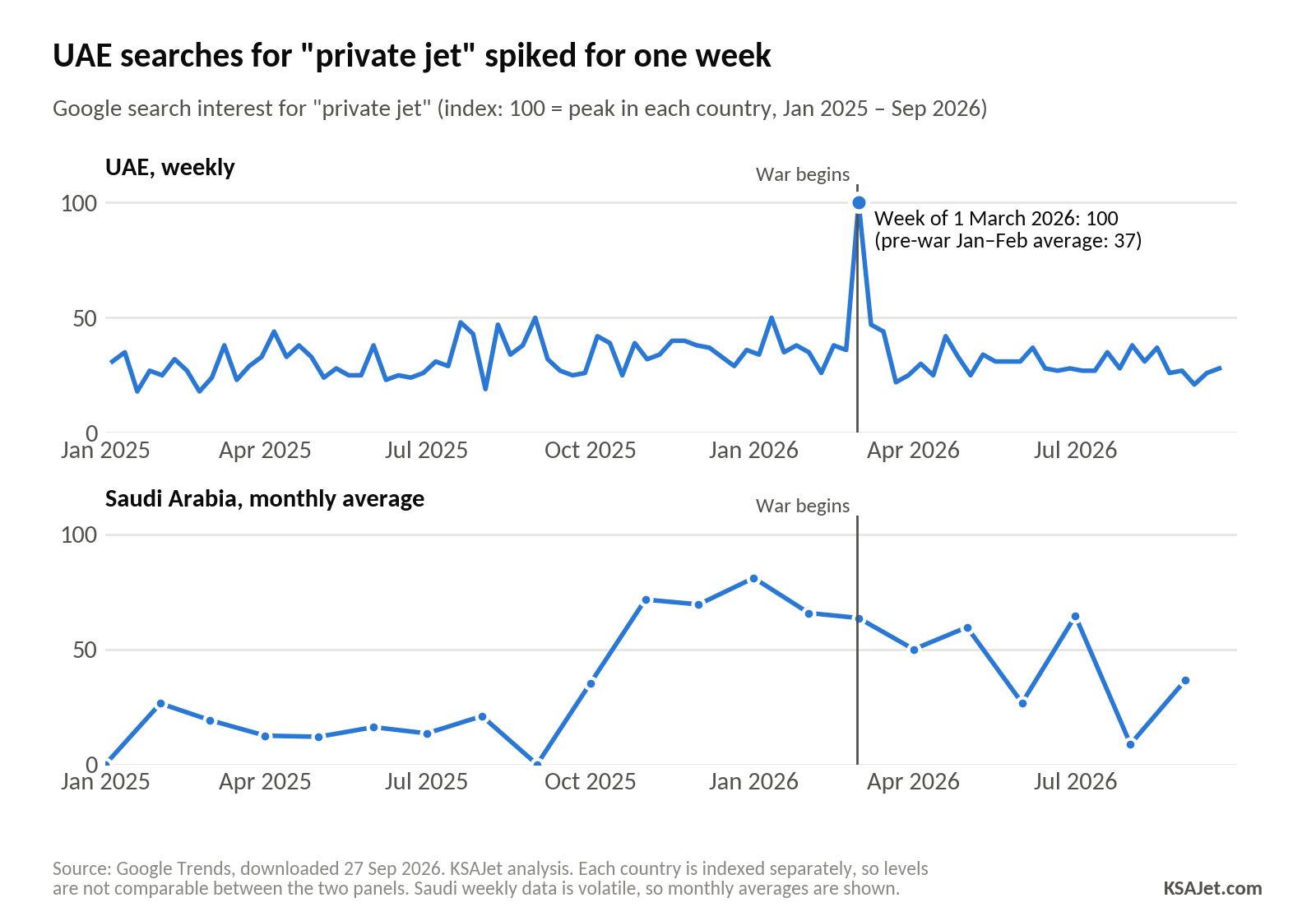
Saudi Arabia showed no comparable spike. Search interest in the week of 1 March (80) was in line with the eight weeks before (average 73), and the monthly average for March (64) was below January’s (81). Interest in private jets had already risen from October 2025 [14]. The contrast is consistent with Saudi Arabia’s role as an open route out (section 13), although search data alone cannot show why searches differed between the two countries.
Arabic-language searches for private-jet terms were far fewer. Google Trends reported a figure in only a handful of weeks in either country [14]. On Ahrefs’ estimates, Saudi Arabia accounted for the largest share of searches for the standard Arabic term for “private jet”, ahead of the UAE [72], and for most searches for the Arabic term for “private aviation” [72].
15. Outlook
This outlook is based on data available to 20 September 2026. The conflict had not ended by 2 September. A further round of US strikes on Iran, and Iranian attacks on US bases, was reported by OPSGROUP on 2 September [16], and EASA had extended its bulletin on the Persian Gulf and Gulf of Oman to 30 September, with revised recommendations [41]. Scheduled airline capacity was returning, which reduced the need to charter for travellers who had a choice: by September, airline capacity at Dubai was back to 84% of previous levels [73].
The table shows the status of each GCC state’s airspace as OPSGROUP reported it on 2 September. Five were open, most with restrictions, and Kuwait was closed to overflights:
| State | Status as reported on 2 September 2026 | Source |
|---|---|---|
| Saudi Arabia | Open, and carrying much of the traffic routed south around the conflict zone | [16] |
| Oman | Open, with flow measures and GPS interference. Operators advised to keep avoiding the Gulf of Oman west of 58°E | [16] |
| UAE | Open, with temporary routings and flow restrictions | [16] |
| Qatar | Open to overflights and landings; some flow restrictions towards Oman | [16] |
| Bahrain | Open; restrictions in neighbouring airspace affected onward routing | [16] |
| Kuwait | Closed to overflights, at that point until 2 October; arrivals and departures only with prior approval | [16] |
At this report’s cut-off on 20 September 2026, four indicators were the ones to watch for a recovery in Gulf private aviation:
- The gap between total private departures and charter and fractional departures in WingX’s weekly data. A narrowing gap would mean travellers who hire jets are returning. In the week to 20 September, charter and fractional flights were 38% below 2025, the largest shortfall in any week since late June for which KSAJet obtained figures [1, 59, 60, 61, 62, 63, 64, 65].
- Whether private flights from the Gulf states close the gap with the wider Middle East.
- War-risk premiums and airspace advisories, which set the cost floor for charter prices.
- Attendance at the MEBAA Show, the Middle East’s main private-aviation show, run by the Middle East & North Africa Business Aviation Association and scheduled, as of early October 2026, for 8–10 December 2026 at Dubai World Central [69]. In August the organisers expected more than 100 exhibitors [74], against 145 exhibitors and 10,000 attendees at the 2024 show [75].
For Saudi Arabia, the longer-term picture is set by GACA’s targets for 2030 [23], including a reported goal for 90% of Saudi-owned private jets to be based in the Kingdom [29].
16. Methodology and limitations
Approach. This report is based on published sources. KSAJet did not collect flight data of its own. The sources were published between 28 February and 27 September 2026, plus pre-war baseline data and one later release, JETNET iQ’s September barometer of 5 October 2026. The MEBAA Show dates were checked again on the organiser’s website on 7 October 2026. Every figure was verified against its source, and the sentence containing it was recorded. Where the original page could not be opened (paywalled or blocked pages), the figure was confirmed in a syndicated copy of the same article, in the underlying data presentation, or in an Arabic-language version of the same report. Arabic sources were also searched for Saudi-specific figures. Where a figure was reported second-hand, the original source (for example WingX, Cirium, IATA or the Financial Times) is named. Figures are reported as published, including their rounding. Where the report says where a company is based, that was checked against the cited article, the company’s own website or a company register.
Review. An editorial review of the report’s structure and scope was carried out by Ibtasaam Sajid, BS (Honors) Aircraft Maintenance Technology, The University of Lahore. The figures were checked against their sources by KSAJet.
JETNET iQ Market Barometer. Several regional figures come from the full August 2026 edition of the JETNET iQ Market Barometer, which publishes WingX data. KSAJet obtained it through JETNET’s download page; the report cites its figures without reproducing its charts, and Figure 9 was redrawn by KSAJet from the published numbers. The August monthly figure and the later statement on fuel prices come from JETNET’s published summary of the September 2026 edition, dated 5 October.
KSAJet analysis. Two parts of this report are KSAJet’s own work: the estimates of non-charter private flights and of the charter share in section 10, calculated from WingX’s published figures, and the search-data analysis in section 14. Both are labelled wherever they appear.
Search data. Google Trends weekly data for “private jet” and four Arabic terms, Saudi Arabia and the UAE, January 2025 to September 2026, downloaded on 27 September 2026. Google Trends reports a relative index (100 = the highest week for that term and country) based on a sample of searches, so levels cannot be compared between countries and repeat downloads can differ slightly. Saudi weekly values are volatile, so monthly averages are shown in Figure 10. Ahrefs figures are modelled estimates.
Definitions. “Private jets” is used for what WingX, GACA and other industry sources call “business jets” or “business aviation”; it does not refer to business-class airline seats. WingX does not publish the list of countries in its “Middle East” region. One article reported its managing director as saying that data “across the UAE, Saudi Arabia, Turkey, and, to some extent, Israel” showed Turkey had the most private jets “in the region” [76], while other reports of WingX data treat Turkey as a destination outside the region. Either way, the region is wider than the GCC, so WingX regional figures are the closest available measure for the GCC but are not a GCC count. No 2026 country-level private-jet figures were found for Qatar, Bahrain, Kuwait or Oman. “Charter and fractional” refers to flights by commercial charter operators and fractional-ownership programmes (Part 135 and Part 91K in WingX’s categories). “Non-charter private flights” are what is left when those are subtracted from all departures. WingX does not publish what that remainder contains, so this report does not attribute it to any one type of user. Operator figures refer to single companies and are not national totals.
Limitations. Price examples are individual quotes and bookings reported by brokers and operators, not market averages. KSAJet found no published 2026 private-jet movement data for Saudi airports. The most recent private-aviation data used in this report covers the week to 20 September 2026. Separate figures for weeks 35–37 (24 August–13 September) were not obtained; KSAJet derived their combined total from WingX’s four-week and weekly figures. Airspace status is as OPSGROUP reported it on 2 September 2026. OPSGROUP rewrites its airspace page as conditions change, so the page may no longer show the statements cited here. This report does not cover events after 20 September 2026. Year-on-year weekly comparisons in February–April are affected by Ramadan and Eid falling about 11 days earlier in 2026 than in 2025. WingX did not publish the comparison baseline for its first-days figures (−26% and −52%). This report does not use KSAJet’s own website traffic or customer data.
Corrections. If you believe a figure in this report is wrong, contact research@ksajet.com. Corrections will be noted on the report’s web page.
Add to this study
An open invitation. This report is built from published sources, and some questions could not be answered from them. KSAJet invites operators, brokers, airports, terminal operators, insurers and anyone else with data or first-hand experience of the period to add to it, correct it or supplement it.
The main gaps are:
- Private-jet movement figures for Saudi airports in 2026 (section 13).
- Who was flying the non-charter private flights (section 10).
- Who hires private jets in Saudi Arabia and the Gulf, by type of traveller (section 5).
- Figures from Gulf-based operators and brokers, and the other gaps listed in section 12.
- Country totals for private-jet flights in 2026 for Qatar, Bahrain, Kuwait and Oman (section 16).
Write to research@ksajet.com. This report was first published on 8 October 2026. If contributions arrive, it will be updated, and each update will be dated.
How to cite this report
KSAJet Research (2026). Private Aviation in the GCC and Wider Middle East During the 2026 US–Iran Conflict: Total private flying neared 2025 levels. Charter and fractional flying did not. KSAJet.com. https://ksajet.com/research/gcc-private-aviation-us-iran-conflict-2026/
The charts in this report may be reused with credit to KSAJet and a link to the web address above.
Sources
- [1] Private Jet Card Comparisons – Private Jet Flight Activity Analysis – 2026 – Week 38 (Doug Gollan), 2026-09-24. Data: WingX. https://privatejetcardcomparisons.com/2026/09/23/private-jet-flight-activity-analysis-2026-week-38/
- [2] JETNET iQ (JIQ) Market Barometer, August 2026, Edition 6, 2026-08-26. Data: WINGX / JETNET iQ. https://www.jetnet.com/resources/blog/jiq-market-barometer-august-2026-edition-6
- [3] Middle East Eye, 2026-08-16. Data: WINGX (analyst Nick Koscinski, comments to MEE). https://www.middleeasteye.net/news/middle-eastern-airlines-lose-43bn-2026-amid-iran-war
- [4] Tourism Daily News (Arabic), Hanan Khalil, 2026-07-03. Data: WingX Advance. https://tourismdailynews.com/2026/07/03/%D8%AD%D8%B1%D8%A8-%D8%A5%D9%8A%D8%B1%D8%A7%D9%86-%D8%AA%D9%87%D8%A8%D8%B7-%D8%A8%D8%AD%D8%B1%D9%83%D8%A9-%D8%A7%D9%84%D8%B7%D9%8A%D8%B1%D8%A7%D9%86-%D8%A7%D9%84%D8%AE%D8%A7%D8%B5-%D9%81%D9%8A-%D8%A7/
- [5] WingX Advance, presentation to the BBGA conference (March 2026), 2026-03-12. https://bbga.aero/wp-content/uploads/2026/03/BBGA_WINGX_2026_final2.pdf
- [6] Fox Business / Fox News (Alexandra Koch, Rachel Wolf), 2026-03-05. Data: Flightradar24. https://www.foxnews.com/world/private-flights-account-departures-oman-airport-wealthy-evacuate-middle-east.print
- [7] CNN, 2026-03-12. Data: Company statement (SHY Aviation). https://www.cnn.com/2026/03/12/travel/middle-east-private-jets-scli-intl
- [8] Reuters (Abir Al Ahmar and Federico Maccioni), 2026-03-06. Data: Broker statement (Jet VIP) to Reuters. https://www.reuters.com/world/middle-east/private-jets-emerge-alternative-way-out-gulf-iran-conflict-intensifies-2026-03-06/
- [9] Khaleej Times (Waheed Abbas), 2026-03-31. Data: Jetex (Adel Mardini). https://www.khaleejtimes.com/business/aviation/160k-dubai-istanbul-flight-cost-oil-prices-insurance-rise
- [10] Financial Times (via Seoul Economic Daily; also AirGuide/FlightAware), 2026-03-22. Data: Charter brokers quoted by FT (e.g. Charles Robinson, Enterjet). https://en.sedaily.com/international/2026/03/23/charter-flight-war-insurance-to-middle-east-surges-to-50000
- [11] AIN (Aviation International News), 2026-03-12. Data: WingX Advance. https://www.ainonline.com/aviation-news/business-aviation/2026-03-12/wingx-reports-some-bizav-stablization-iran-war
- [12] Private Jet Card Comparisons, 2026-03-12. Data: WingX. https://privatejetcardcomparisons.com/2026/03/12/private-jet-flight-activity-analysis-2026-week-10/
- [13] Google Trends (downloaded 27 Sep 2026), KSAJet analysis, 2026-09-27. https://trends.google.com/trends/explore?date=2025-01-01%202026-09-27&geo=AE
- [14] Google Trends (downloaded 27 Sep 2026), KSAJet analysis, 2026-09-27. https://trends.google.com/trends/explore?date=2025-01-01%202026-09-27&geo=SA
- [15] Al Arabiya English (Darshan Dalal), 2026-03-06. https://english.alarabiya.net/News/saudi-arabia/2026/03/06/riyadh-becomes-key-exit-route-as-gulf-travelers-scramble-for-flights-amid-iran-war
- [16] OPSGROUP (ops.group blog; the page is rewritten as conditions change and is cited as it stood on 2 September 2026), 2026-09-02. https://ops.group/blog/middle-east-airspace-current-operational-picture/
- [17] Forbes (Mary Roeloffs), 2026-03-02. Data: Brokerage spokespeople (incl. Altay Kula, JetVIP) quoted by Forbes. https://www.forbes.com/sites/maryroeloffs/2026/03/02/private-jet-prices-soar-for-wealthy-tourists-desperate-to-leave-dubai/
- [18] CNBC (Robert Frank, Hayley Cuccinello); checked on CNBC Africa copy, 2026-03-05. Data: Ameerh Naran, CEO, Vimana Private Jets (interview statement). https://www.cnbc.com/2026/03/05/iran-war-dubai-rich.html
- [19] Inflight, 2026-03-05. Data: WingX Global Market Tracker. https://www.inflight-online.com/wingx-weekly-report-shows-the-impact-of-the-middle-east-conflict-on-aviation
- [20] IATA press release No. 26, 2026-06-07. https://www.iata.org/en/pressroom/2026-releases/06-07-middle-east-disruptions-high-fuel-prices-halve-airline-industry-profitability/
- [21] JETNET iQ (JIQ) Market Barometer, April 2026, Edition 2, 2026-05-07. https://www.jetnet.com/resources/blog/the-business-aviation-market-is-up-5.-so-why-is-the-pre-owned-market-stalling
- [22] AvBuyer (Gerrard Cowan), 2024-11-28. Data: WingX. https://www.avbuyer.com/articles/business-aviation-market-analysis/the-latest-middle-east-business-aviation-market-trends-114060
- [23] GACA (gaca.gov.sa news), 2025-02-04. https://gaca.gov.sa/en/News/gaca-opens-domestic-aviation-market
- [24] Aviation Pros (GACA press release), 2025-01-22. https://www.aviationpros.com/aircraft/press-release/55262511/gaca-reports-record-saudi-business-jet-growth-in-2024-private-aviation-set-to-become-a-2-billion-sector
- [25] Dubai Media Office (2025 figure); ZAWYA/WAM-syndicated (2024 figure), 2026-02-11. https://mediaoffice.ae/en/news/2026/february/11-02/dubai-south-achieves
- [26] Airbus Corporate Jets (newsroom), 2025-12-08. Data: WingX (Airbus Corporate Jets analysis, November 2025). https://www.acj.airbus.com/en/newsroom/stories/2025-12-acj-says-economic-growth-in-saudi-arabia-is-driving-demand-for-business
- [27] Al Arabiya English, 2025-03-13. Data: GACA. https://english.alarabiya.net/News/saudi-arabia/2025/03/13/saudi-arabia-s-private-aviation-sector-soars-amid-new-reforms-growing-workforce0
- [28] GACA (gaca.gov.sa news, ‘Saudi Civil Aviation Sector in 2025: Major Achievements and Strategic Expansion’), 2026-02-01. https://gaca.gov.sa/en/News/civil-aviation-saudi-achievements-2025
- [29] The National (Deena Kamel), 2024-05-24. Data: Vista (operator). https://www.thenationalnews.com/business/aviation/2024/05/24/saudi-arabia-anticipates-strong-investor-demand-for-private-jet-industry/
- [30] VistaJet press release (PR Newswire), 2025-08-20. https://www.prnewswire.com/news-releases/vistajet-first-to-fly-within-the-kingdom-of-saudi-arabia-further-expanding-domestic-flight-solutions-302534520.html
- [31] Air Cargo News, 2025-09-11. https://www.aircargonews.net/charter-company/acs-expands-into-saudi-arabia-with-new-riyadh-office/1080633.article
- [32] Al Jazeera, 2026-02-28. https://www.aljazeera.com/news/2026/2/28/airspace-closed-airlines-halt-flights-as-us-israel-attack-iran-responds
- [33] EASA (CZIB 2026-03-R14, Airspace of the Middle East and Persian Gulf), 2026-07-01. https://www.easa.europa.eu/en/domains/air-operations/czibs/2026-03-r14
- [34] Gulf News, 2026-04-23. Data: Kuwait DGCA (via Gulf News). https://gulfnews.com/world/gulf/kuwait/kuwait-reopens-airspace-after-two-month-closure-1.500517295
- [35] Associated Press via PBS NewsHour (same AP text carried by NPR), 2026-06-03. https://www.pbs.org/newshour/world/iran-strikes-kuwaits-main-airport-and-kills-1-as-ceasefire-is-tested-again
- [36] Safe Airspace (OPSGROUP; summary page, updated in place), 2026-07-08. https://safeairspace.net/summary/
- [37] TIME, 2026-07-09. https://time.com/article/2026/07/09/us-iran-strikes-trump-ceasefire-gulf-region/
- [38] EASA news: Revised conflict zone advisories for Middle East, 2026-07-08. https://www.easa.europa.eu/en/newsroom-and-events/news/revised-conflict-zone-advisories-middle-east
- [39] EASA (CZIB-2026-07, Airspace of the Persian Gulf and Gulf of Oman), 2026-07-14. https://www.easa.europa.eu/en/domains/air-operations/czibs/czib-2026-07r1
- [40] AeroTime (Stephen Pope), 2026-07-18. https://www.aerotime.aero/articles/kuwait-closes-airspace-iranian-missile-drone-attacks
- [41] EASA (CZIB-2026-07R2), 2026-08-31. https://www.easa.europa.eu/en/domains/air-operations/czibs/czib-2026-07r2
- [42] Business Jet Traveler (Curt Epstein); also Private Jet Card Comparisons, week 11, 2026-03-19. Data: WingX. https://www.bjtonline.com/business-jet-news/middle-east-conflict-continues-to-weigh-on-private-aviation
- [43] International Airport Review, 2026-03-16. Data: Cirium. https://www.internationalairportreview.com/middle-east-flight-cancellations-exceed-50-percent-since-february-amid-ongoing-regional-disruption/1672118.article
- [44] Private Jet Card Comparisons (Doug Gollan), 2026-03-14. Data: Air Charter Service (broker statement). https://privatejetcardcomparisons.com/2026/03/14/air-charter-service-wheels-up-highlight-emergency-evacuations/
- [45] Skift, 2026-03-05. Data: Mayfair Jets (company statement to Skift). https://skift.com/2026/03/05/300-increase-in-private-jet-demand-in-uae-charter-provider-claims/
- [46] Arabian Business (Tala Michel Issa), 2026-03-13. https://www.arabianbusiness.com/business/transport/first-time-private-jet-users-surge-as-gulf-flight-disruptions-drive-charter-demand
- [47] AeroTime (Stephen Pope), 2026-03-06. Data: Kyle Patel, Bitlux (small broker). https://www.aerotime.aero/articles/dubai-evacuation-private-jet-price-gouging-charter-market
- [48] TradeArabia News Service (syndicated by Zawya, TTN, Gulf Daily News); Arabic: Al-Watan (Saudi Arabia), 2026-07-27. Data: XO / Vista booking activity across XO’s global marketplace (company press release). https://tradearabia.com/News/465624/GCC-private-jet-demand-surges-as-travellers-seek-flexibility-XO-analysis
- [49] AGBI (Arabian Gulf Business Insight), Edmund Bower, 2026-03-03. Data: Universal Jets (Dubai operator) CEO; VistaJet. https://www.agbi.com/aviation/2026/03/gulf-private-jet-operators-report-doubling-of-prices/
- [50] Associated Press (carried by WRAL), 2026-03-03. Data: Broker statements (JET-VIP; Vimana Private Jets). https://www.wral.com/news/ap/9f2af-some-travelers-stranded-in-dubai-are-paying-huge-sums-for-private-flights-out/
- [51] CNBC, 2026-04-03. Data: Vimana Private Jets (company statement); Amalfi Jets booking database. https://www.cnbc.com/2026/04/03/private-jet-travel-costs-rise-fuel-prices.html
- [52] Fox Business, 2026-04-20. Data: IATA Jet Fuel Price Index. https://www.foxbusiness.com/economy/soaring-jet-fuel-prices-threaten-drive-up-summer-travel-costs
- [53] IATA (Fuel Fact Sheet), 2026-06. https://www.iata.org/en/iata-repository/pressroom/fact-sheets/fact-sheet-fuel/
- [54] AGBI (opinion), 2026-09. Data: Financial Times report (March 2026), via Insurance Business. https://www.agbi.com/opinion/economy/2026/09/the-gulf-is-paying-the-price-of-risk/
- [55] JETNET iQ (JIQ) Market Barometer, September 2026, Edition 7, 2026-10-05. Data: WINGX / JETNET iQ. https://www.jetnet.com/resources/blog/middle-east-clawing-back-while-global-activity-utilization-and-order-books-push-higher-through-august
- [56] Private Jet Card Comparisons, 2026-04-02. Data: WingX. https://privatejetcardcomparisons.com/2026/04/02/private-jet-flight-activity-analysis-2026-week-13/
- [57] JETNET iQ (JIQ) Market Barometer, June 2026, Edition 4, 2026-07-02. Data: WingX / JETNET iQ. https://www.jetnet.com/resources/blog/jetnet-iq-market-monitor-june-26-edition-4
- [58] JETNET iQ (JIQ) Market Barometer, July 2026, Edition 5, 2026-07-29. Data: WINGX (via JETNET iQ joint barometer). https://www.jetnet.com/resources/blog/mid-2026-market-snapshot
- [59] Private Jet Card Comparisons – Private Jet Flight Activity Analysis 2026 Week 26, 2026-07-02. Data: WingX. https://privatejetcardcomparisons.com/2026/07/02/private-jet-flight-activity-analysis-2026-week-26/
- [60] Private Jet Card Comparisons – Week 27, 2026-07-13. Data: WingX. https://privatejetcardcomparisons.com/2026/07/13/private-jet-flight-activity-analysis-2026-week-27/
- [61] Private Jet Card Comparisons – Week 29, 2026-07-23. Data: WingX. https://privatejetcardcomparisons.com/2026/07/23/private-jet-flight-activity-analysis-2026-week-29/
- [62] Private Jet Card Comparisons – Week 30, 2026-07-30. Data: WingX. https://privatejetcardcomparisons.com/2026/07/30/private-jet-flight-activity-analysis-2026-week-30/
- [63] Private Jet Card Comparisons – Private Jet Flight Activity Analysis – 2026 – Week 31, 2026-08-06. https://privatejetcardcomparisons.com/2026/08/06/private-jet-flight-activity-analysis-2026-week-31/
- [64] Private Jet Card Comparisons – Week 32, 2026-08-14. Data: WingX. https://privatejetcardcomparisons.com/2026/08/14/private-jet-flight-activity-analysis-2026-week-32/
- [65] Private Jet Card Comparisons – Week 34, 2026-08-27. Data: WingX. https://privatejetcardcomparisons.com/2026/08/27/private-jet-flight-activity-analysis-2026-week-34/
- [66] Private Jet Card Comparisons, Doug Gollan, ‘U.S., fractional, charter operators drive continued private jet growth’, 2026-07-09. Data: WingX. https://privatejetcardcomparisons.com/2026/07/09/u-s-fractional-charter-operators-drive-continued-private-jet-growth/
- [67] Forbes (Doug Gollan), 2026-03-02. Data: LunaJets (Gaspard Boscher). https://www.forbes.com/sites/douggollan/2026/03/02/iran-conflict-spurs-issues-for-private-jet-flyers-beyond-price-spikes/
- [68] FlightGlobal (Jon Hemmerdinger), 2026-04-29. Data: General Dynamics/Gulfstream Q1 2026 results, as reported by FlightGlobal. https://www.flightglobal.com/air-transport/2026/04/gulfstream-momentum-checked-by-middle-east-conflict/
- [69] MEBAA Show official site (mebaa.com), accessed 2026-10-07. https://www.mebaa.com/mebaa-show-2026
- [70] Asharq Al-Awsat (English), 2026-03-16. https://english.aawsat.com/gulf/5251771-saudi-arabia-becomes-region%E2%80%99s-key-transit-hub-war-disrupts-gulf-airspace
- [71] GlobalAir.com (Jadda Tyree), citing WingX, 2026-03-06. https://www.globalair.com/articles/business-aviation-activity-drops-in-middle-east-due-to-iran-israel-us-conflict/12029
- [72] Ahrefs Keywords Explorer, 2026-08-27. https://ahrefs.com/keywords-explorer
- [73] The National, 2026-09-11. Data: Paul Griffiths, CEO, Dubai Airports. https://www.thenationalnews.com/news/uae/2026/09/11/dxb-dubai-airports-paul-griffiths-dwc-plans/
- [74] Aviation International News (Charles Alcock), 2026-08-13. Data: MEBAA Show organisers via AIN. https://www.ainonline.com/aviation-news/business-aviation/2026-08-13/mebaa-2026-show-says-100-plus-exhibitors-expected
- [75] Breaking Travel News, 2026-07-17. Data: MEBAA press release. https://www.breakingtravelnews.com/news/article/mebaa-show-returns-to-spotlight-the-value-of-business-aviation/
- [76] Aerospace Global News (Chloe Greenbank), 2026-03-14. Data: WingX (Richard Koe, Managing Director). https://aerospaceglobalnews.com/news/how-geopolitical-tension-in-the-middle-east-is-impacting-business-aviation/
About KSAJet
KSAJet.com is an Arabic-language information platform on private aviation. Based in Riyadh, it serves the GCC and the wider Arab world. KSAJet may earn referral fees when readers request or book flights through the site. No broker or operator reviewed or funded this report.
Contact: research@ksajet.com · ksajet.com